The Illuminati was made an offer they could not refuse: They were so busy proclaiming their own awesomeness it never occured to any of them that they ought to let Johnny Fontaine go.
He did not understand the significance of the lower offer.
The Godfather — Mario Puzo
(It was never a negotiation, it was a command; and it was not for him to propose a counter offer.)
The Story of Thamud and the Camel of God
Why this story matters beyond your own scripture
The story of Thamud and the camel of God is one of the Qur’an’s most emphasized narratives: it appears in full four times and is referenced nine more times, far more than any other destruction story. Yet it does not appear in the Old Testament or the New Testament at all. This makes it a prime example of why reading scriptures outside one’s own tradition can reveal moral structures, historical memories, and symbolic patterns preserved in one lineage but absent in another.
We have never sent a messenger who did not eat food and walk in the marketplaces.
My only income is voluntary donations.
If you would like to support this work, you may give through Cash App:
Cash App:
https://cash.app/$phirunltd
If you do not use Cash App, you can donate through Gumroad by entering any amount and downloading my ebook:
Gumroad:
Donate via Gumroad
The ebook remains free for everyone. You can download it here:
Free Ebook:
Download on GitHub
Thamud’s society and the arrival of the sign
The people of Thamud lived in the rocky lands north of Medina, carving their homes into mountains and cliffs. Their actual ruins have never been found, but the rose-red city of Petra remains a vivid reminder of the kind of rock-cut architecture the Qur’an describes. Thamud were wealthy, proud, and confident in their mastery over stone and desert. Into this society, God sent the prophet Ṣāliḥ, calling them to righteousness and urging them to worship God alone. Their response was to demand a miracle — a sign they could see with their own eyes.
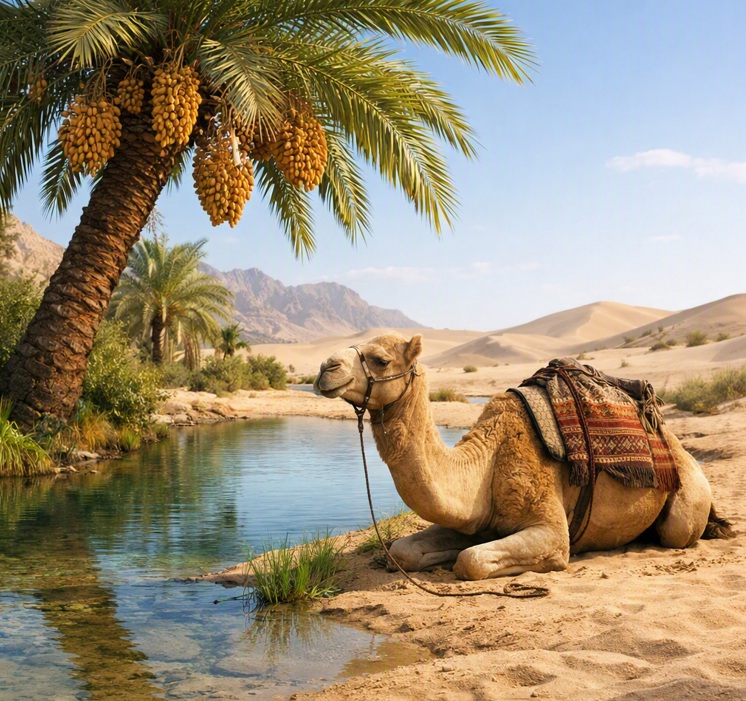
God answered with a miracle unlike any other: a camel brought forth from solid rock. Ṣāliḥ declared, “This is Nāqat Allāh — the camel of God,” and explained that the camel was a sign, a test, and a gift. The camel itself is a symbol of peace, travel, and abundance in the desert — a creature associated with survival, generosity, and divine provision. It drank from the communal well one day while the people drank the next, roamed freely wherever it wished, and provided milk, symbolizing food and nourishment. The instructions were clear: the camel was not to be confined, restricted, driven away, or harmed. The gift was generous, but it came with boundaries — a divine covenant expressed through a living creature.
The grievances that ignited the tragedy
Not everyone welcomed the camel. Its presence disrupted the routines of certain elites. It drank enormous amounts of water on its day, wandered freely through the settlement, and grazed in places people considered private. Two women in particular felt that the camel threatened their way of life. One woman’s own camel panicked whenever the miracle-camel approached, endangering her livelihood. The other woman’s garden had been trampled, damaging her property and undermining her status. Both women became vocal critics of the camel and offered rewards to anyone who would kill it. Their grievances — personal, economic, and social — became the spark that ignited the tragedy.
Symbolic meanings of the names
Women of Thamud (symbolic roles)
- Fear‑Bearer: The woman whose camel panicked whenever the miracle‑camel approached, symbolizing fear of change, economic insecurity, and grievance that becomes social agitation.
- Pride‑Bearer: The woman whose garden was damaged, symbolizing status anxiety, resentment over property, and corrupt bargaining — including offering her own daughter as a reward to the killer.
Nine men of Thamud (name meanings)
Classical tafsīr preserves the names of nine men described in the Qur’an as those who “spread corruption in the land.” Their meanings can be read symbolically:
- Qidār: “Darkness” or “gloom”; a symbol of moral obscurity and spiritual blindness.
- Musaddad: “Hardened” or “made firm”; a symbol of stubborn rebellion against guidance.
- Dhiʾāb: “Wolf”; a symbol of predatory intent and exploitation of others.
- Habbāb: “Inciter” or “agitator”; a symbol of stirring unrest and spreading corruption.
- Rāshid: “Guided” or “upright”; an ironic symbol of guidance misused in service of wrongdoing.
- Dāʿiʿ: “Caller” or “summoner”; a symbol of rallying others into a corrupt cause.
- Mutaʿallil: “Excuse‑maker”; a symbol of self‑justification and rationalizing sin.
- Muʿtarr: “Obstructor”; a symbol of blocking truth and hindering righteousness.
- Qushayṭir: “Crooked” or “twisted”; a symbol of moral distortion and deviation from the straight path.
These men, wealthy and influential, formed a secret pact to kill the camel and then assassinate Ṣāliḥ, believing they could blame outsiders and escape consequences. Before killing the camel, they hobbled it — binding or cutting its legs so it could not roam free as God had commanded. This act was itself a violation of the divine instructions, a deliberate attempt to strip the camel of the freedom it had been granted as part of the test. Only after immobilizing the camel did they strike. The divine sign was destroyed. The test was failed. The gift was rejected.
The three‑day countdown and total destruction
When the people awoke to find the camel dead, Ṣāliḥ warned them that they had crossed a boundary from which there was no return. “You have three days,” he told them. “After that, destruction will come.” They mocked him, confident in their power and dismissive of his warning. But on the third day, the punishment arrived. The Qur’an describes a terrible blast — a thunderous cry, a quake, a shout that left the people lifeless in their homes. The nine conspirators were destroyed first, followed by the entire nation.
Classical tradition even mentions a supposed survivor named Abū Righāl, whose name was interpreted symbolically to mean “they were all complicit.” His survival was not mercy but symbolism: he remained only to demonstrate that the guilt was collective. Later Arab tribes treated his grave as a symbol of treachery, reinforcing the idea that Thamud’s destruction was total because their guilt was shared. Like the story of Sodom and Gomorrah, the destruction of Thamud left no survivors in the sense of an innocent remnant. Only Ṣāliḥ and the believers survived, leaving behind a landscape of ruins and a story repeated throughout the Qur’an as a warning to later generations.
A prophetic warning centuries later
Centuries later, when Muhammad passed through the region associated with Thamud, he instructed his companions not to drink the water from the wells where the destruction had occurred. Some companions had already drawn water and prepared dough with it, but Muhammad told them to throw it away and not consume anything made from that water. He explained that this was the place where God’s punishment descended, and that believers should not drink from the sources of a people who had rejected a divine sign. This prophetic instruction reinforced the idea that Thamud’s land remained a warning to all who came after.
The sequel motif in Surah 91
The final verse of Surah 91 is striking because the entire chapter presents the story of Thamud with no additional legal instruction, ritual command, or narrative diversion. It is a pure moral case study. After recounting the killing of the camel and the destruction that followed, the chapter ends with the line: “He does not fear its sequel.” This closing phrase is unique among the Qur’an’s destruction narratives. Rather than signaling finality, it implies continuation — that the divine gift and the divine test were intended to occur again. This structural feature helps explain why the Thamud narrative appears four times in full and nine more times in reference, far more than any other destruction story, yet is absent from both the Old Testament and the New Testament.
A modern foreshadowing: Wild Bill Hickok and Deadwood
In my eBook The End of Time, I included an inset about the life and death of Wild Bill Hickok. At first glance it seems out of context, but it is not. Hickok entered Deadwood quietly, harming no one, trying only to earn a little money for himself. Yet he was feared by the locals and ultimately shot in the back by a drifter he had personally fed. In this author’s view, Hickok’s life is a modern foreshadowing of the divine camel of God reappearing. Surah 91 ends with the line, “He does not fear its sequel,” implying that the test was meant to recur. Hickok’s story echoes the same pattern: a peaceful sign, irrational fear, corrupt pressure, betrayal by one helped, and destruction from behind. It is a shadow of the sequel the Qur’an structurally anticipates.
Three years after Wild Bill Hickok was killed, Deadwood itself burned to the ground — a structural echo of the three‑day countdown given to Thamud after the killing of the camel. The timing is even more striking: the fire occurred on Yom Kippur, the Day of Atonement, the day associated with judgment and the sealing of fate. In this author’s view, Hickok’s peaceful arrival, the community’s irrational fear, his betrayal by someone he helped, and the subsequent destruction of Deadwood form a modern recurrence of the same moral architecture found in the Thamud narrative. Surah 91 ends with the line, “He does not fear its sequel,” implying that the divine test was meant to recur. Deadwood’s destruction on Yom Kippur is a forward echo of that sequel motif.
The reader’s moral participation
By including this story in the narrative, most readers can instinctively “shake their fists” and agree that the actions of the people of Thamud were despicable. Their betrayal of a peaceful, miraculous gift — a living sign of divine generosity — evokes universal outrage. Few would disagree that they deserved to be destroyed for defiling such a wonder. This shared moral reaction is precisely the point: the story invites the reader to recognize the justice of the outcome, to feel the weight of the gift that was rejected, and to understand why the destruction was total. In that recognition, the reader participates in the same moral test — affirming that the gift was sacred and that its violation demanded consequence.