The Clenched Fist Trap
Description and Mechanism
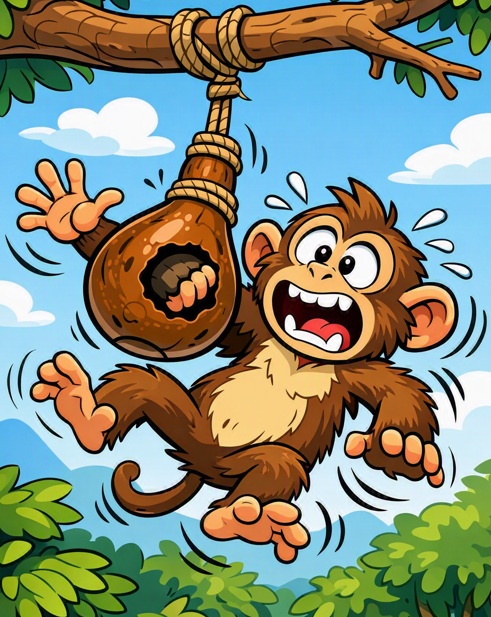
A clenched fist trap is a simple yet effective device used to capture monkeys. It consists of a hollow gourd or container with a small opening just large enough for a monkey to insert its hand. Inside the gourd lies bait—often fruit or nuts. When the monkey reaches in and grabs the bait, its hand forms a fist, making it too large to withdraw through the narrow opening. The monkey could easily escape by releasing the bait, but its instinct to hold on keeps it trapped.
This mechanism illustrates a profound behavioral truth: the trap doesn’t imprison the monkey—the monkey’s own refusal to let go does. The design exploits grasping behavior, turning desire into confinement.
We have never sent a messenger who did not eat food and walk in the marketplaces.
My only income is voluntary donations.
If you would like to support this work, you may give through Cash App:
Cash App:
https://cash.app/$phirunltd
If you do not use Cash App, you can donate through Gumroad by entering any amount and downloading my ebook:
Gumroad:
Donate via Gumroad
The ebook remains free for everyone. You can download it here:
Free Ebook:
Download on GitHub
Why It’s Inescapable
The clenched fist trap works because of instinctive attachment. Once the monkey closes its hand around the bait, the act of release feels like loss. The monkey struggles, pulls, and panics—but never lets go. The trap is psychological as much as physical: the monkey’s own desire becomes the mechanism of capture.
This principle extends beyond animals. Humans, too, can become trapped by what they refuse to release—possessions, pride, control, or ideology. The clenched fist becomes a metaphor for covetousness, the grasping impulse that binds the will.
Covetousness and the Teaching of Jesus
In the moral architecture of scripture, covetousness is not simply desire. Desire itself is not condemned. Covetousness is a specific kind of desire: wanting what does not belong to you, and especially wanting what belongs to someone else.
In the Hebrew law, this was expressed with precision: “You shall not covet your neighbor’s house, your neighbor’s wife, his servant, his ox, his donkey, or anything that belongs to your neighbor.” The boundary is clear — covetousness is desire directed across the line of ownership.
Jesus strengthens this principle, not by redefining covetousness, but by expanding its scope. He warns, “Beware of covetousness in all its forms.” Instead of limiting the prohibition to a list of specific objects, he identifies the underlying posture: grasping for what is not yours, whether in action, intention, or imagination.
“You have heard that it was said, ‘You shall not commit adultery.’ But I say to you that whoever looks at a woman with lust has already committed adultery with her in his heart.”
By extending the commandment into the realm of thought and motive, Jesus shows that the true trap is within the will. The clenched fist is not around fruit — it is around the desire for what belongs to another. The refusal to release that desire becomes its own form of bondage. Opening the hand becomes the path to liberation.
The Bait
The bait can be fruit, nuts, or any shiny object. Even a toy car can work.
The Monkey's Trap
The monkey isn't trapped by instinct—it is trapped by desire.
Covetousness Defined
Covetousness is wanting what doesn't belong to you. Wanting something isn't the problem—wanting what belongs to someone else is.
Consequences of Covetousness
Covetousness leads to all manner of sin— theft, adultery, even murder.
Scriptural Parallels
The Qur’an uses a striking metaphor for a community that repeatedly violated the Torah and refused correction. After describing their persistent covenant-breaking, it says they were told, “Be apes, despised.”
This is not a biological transformation and not a comment on any modern group. It is a behavioral metaphor: a picture of people abandoning covenantal discipline and collapsing into instinct. In the narrative, their refusal to release forbidden desires leads to a kind of moral regression.
This aligns with the clenched fist trap and the “alligator monkeys” metaphor. Those who grasp what is forbidden believe themselves powerful, clever, or in control — like alligators. But their behavior reveals something else: the closed hand, the instinctive grasping, the inability to release. They do not know they are “monkeys” until the trap exposes them.
In both metaphors, the collapse is the same: when desire becomes grasping, and grasping becomes refusal to release, the will falls back into instinct. The imagery of “despised apes” and “alligator monkeys” expresses the same architecture of self-entrapment — the loss of restraint, the dominance of appetite, and the forfeiture of identity.
In the architecture of this page, the metaphor aligns with the clenched fist trap. When a person refuses to release forbidden desire, the will contracts, the higher nature is forfeited, and the lower nature takes over. The “ape” imagery expresses the same pattern: the loss of restraint, the dominance of appetite, and the forfeiture of the higher form of life they were called to.
Symbolic Interpretation
The clenched fist trap symbolizes the architecture of self‑entrapment:
- Desire → the bait
- Grasping → the act of covetousness
- Attachment → the refusal to release
- Entrapment → the consequence of desire
The monkey’s struggle mirrors the human condition: freedom lies not in force but in surrender. The moment the hand opens, the trap dissolves.
The Final Question
So how does a God who doesn’t violate freewill trap a monkey?
With a clenched fist trap.