Double‑Sided Lock and Key – God Almighty's Mandated Peace Plan
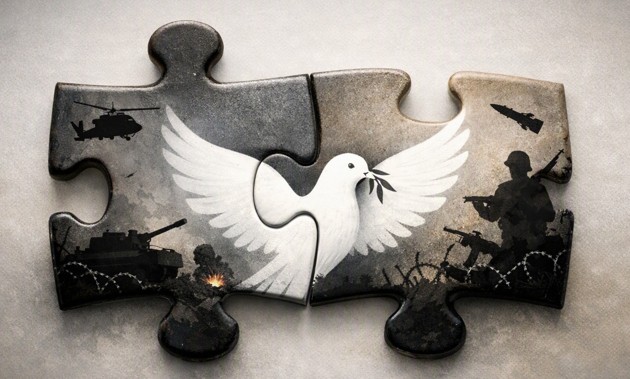
This page presents a non‑political, measurement‑based peace plan for the Middle East. The core idea is that two sides, each bound by their own religious instructions, can fit together like a double‑sided lock and key—each side keeping its own integrity, yet forming a single, stable solution when correctly aligned.
The puzzle image above symbolizes two conflicting sides whose outer edges are defined by war: tanks, weapons, and barbed wire. As they move toward alignment, that conflict fades and a dove of peace emerges—half on each side—forming a complete dove only when the pieces interlock correctly. This mirrors the idea that peace can arise from precise, mutually compatible obedience to existing religious instructions, rather than from political negotiation.
If both sides obey the instructions already present in their own scriptures, the conditions that produce conflict disappear.
The plan works like a “double‑sided lock and key,” where each side has a specific religious instruction that prevents conflict if followed.
In the Old Testament, Israelis are commanded to treat foreigners with kindness, fairness, and hospitality. They must “never mistreat a stranger” and must remember that they themselves were once strangers in Egypt (Exodus 22:21, Leviticus 19:34).
In the Qur’an, God warns believers not to remain in a place where they feel oppressed, helpless, or trapped in conflict. The instruction is clear: if someone feels oppressed, they must “pack up and move to a safer land,” rather than stay in suffering (Qur'an 4:97).
Israel’s instruction in the Old Testament is to treat foreigners with kindness, fairness, and hospitality — never mistreating a stranger, and remembering that they themselves were once strangers in Egypt (Exodus 22:21, Leviticus 19:34).
The Qur’an instructs Muslims not to remain in a place where they feel oppressed or trapped in conflict. If a believer cannot practice faith safely and feels oppressed, they are commanded to relocate to a safer land (Qur’an 4:97).
These two commands interlock:
Together, they remove the two conditions that generate conflict: mistreatment and continued oppression. If both sides follow their own scriptures, the conflict cannot form. This is the “double‑sided lock and key” — two separate commands that only produce peace when both are obeyed.
Both Judaism and Islam contain a seven‑fold internal purification command, and this places the burden squarely on each community itself — not on outsiders. In Deuteronomy, Israel is told seven times to “purge the evil from among you” (Deut 13:5; 17:7; 17:12; 19:19; 21:21; 22:21; 24:7). Every instance is inward‑facing: Israel must address its own destabilizers, its own corrupt actors, its own violent or destructive members. These commands never authorize action against foreigners or neighboring peoples. The responsibility is explicitly internal: Israel must remove destructive elements from Israel — no one else.
Islam mirrors this structure with seven commands to confront those who spread fasād — corruption or societal breakdown — within the believing community (Qur’an 2:11–12; 2:27; 5:33; 7:86; 7:103; 26:151–152; 28:77). These passages describe mufsidūn as internal threats: covenant‑breakers, bandits, violent destabilizers, or hypocrites who undermine communal integrity. As with Deuteronomy, the commands are strictly inward. The Qur’an does not authorize believers to discipline or purge other peoples. The responsibility is internal: Muslims must address corruption within their own ranks — not outside them.
This shared architecture eliminates one of the most common religious arguments used to justify external hostility: “We will not act unless the other group acts first.” Because the commands are internal, they do not depend on the behavior of outsiders. Israel’s obligation to purge its own evil does not hinge on whether Muslims do the same, and Muslims’ obligation to confront their own mischief‑makers does not hinge on whether Israel does. Each community is responsible for its own troublemakers — independently, unconditionally, and without reference to anyone else’s compliance.
And the structure goes further: by assigning purification duties exclusively to the community itself, both traditions implicitly command other groups to stay out of the matter. If Israel is told to purge “from among you,” then outsiders have no religious mandate to intervene. If Muslims are told to confront fasād “among you,” then outsiders have no religious mandate to interfere. The commands are self‑contained. They define the boundaries of responsibility. Each group must govern itself — and must not attempt to govern the other.
Once this is understood, the reciprocal excuse collapses, and the external justification collapses with it. Neither tradition permits a community to delay its own purification on the grounds that “the other side won’t do it,” and neither tradition permits a community to step into the other’s internal affairs. Peace becomes possible not through domination or retaliation, but through each group taking responsibility for its own troublemakers — and only its own.
The conflict persists not because God’s plan failed, but because the instructions are ignored. The solution does not require new negotiations or political agreements — only obedience to what each side already claims to follow.
This is not a political document and does not advocate for any government or faction. It is a technical and religious demonstration that God already provided a complete peace plan, and that the path to stability lies in following the instructions He gave — nothing more, nothing less.
To read the full book, visit:
The End of Time by Raphael E. Asanti — Full Ebook