This page is written to expose the high‑stakes physical reality of global warming, sea‑level rise, and the systems they will overwhelm — not to sensationalize, not to gloss over realistic consequences, but to give readers who might otherwise dismiss the subject as “fear‑porn” the opportunity to consider for themselves what is actually happening in the physical world and how it was foretold 2,000 years ago.
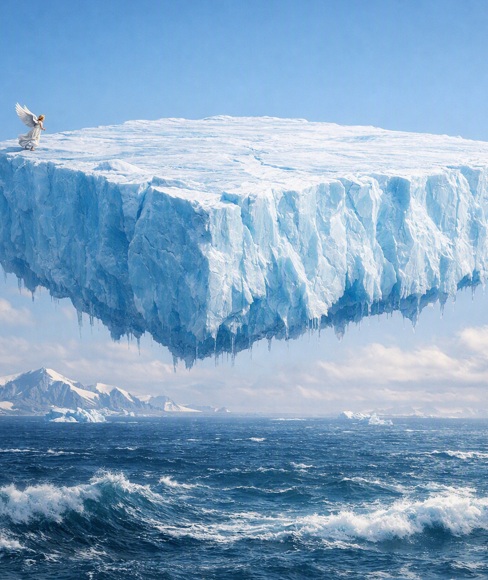
Global Warming and the Destruction of Babylon
Then a mighty angel picked up a stone the size of a great millstone and cast it into the sea, saying: “With such violence the great city of Babylon will be cast down, never to be seen again. 22And the sound of harpists and musicians, of flute players and trumpeters, will never ring out in you again. Nor will any craftsmen of any trade be found in you again, nor the sound of a millstone be heard in you again. — Revelation 18:21-22
John described something “like” a great millstone being thrown into the sea. The word like simply means similar to, not identical. In John’s world, the largest object he could compare to was a millstone — a heavy stone used for grinding grain. He had no concept of glaciers, ice sheets, or continental slabs of ice collapsing into the ocean. Today, global warming is causing exactly that: enormous masses of ice breaking off and plunging into the sea. The ancient symbol aligns with the modern physical reality.
Babylon as a Worldwide System
In Revelation, Babylon is not a single city. It is a worldwide way of life, a global system built on commerce, greed, and idolatry. Babylon represents a civilization that believes it cannot fall because it is wealthy, connected, and powerful. It blinds people with luxury and distraction, convincing them that everything is stable even as it quietly drains the world around it.
Babylon is portrayed as a marketplace overflowing with goods, a culture intoxicated by wealth, and a world order built on exploitation. It collapses suddenly, not because of an external attack, but because the system destroys itself from within. This pattern mirrors the modern world almost exactly. The global system today is built on commerce that never stops, greed that never slows, and idolatry that elevates comfort, entertainment, and wealth above truth.
Support the Work
We have never sent a messenger who did not eat food and walk in the marketplaces.
My only income is voluntary donations.
If you would like to support this work, you may give through Cash App:
Cash App:
https://cash.app/$phirunltd
If you do not use Cash App, you can donate through Gumroad by entering any amount and downloading my ebook:
Gumroad:
Donate via Gumroad
The ebook remains free for everyone. You can download it here:
Free Ebook:
Download on GitHub
What Global Warming Actually Is
Most people think global warming means the planet is simply getting hotter. That is true, but it is only the surface of the problem. Global warming is the breakdown of the planet’s entire life‑support system — the ecosystem and climate engine that make civilization possible.
It affects the air we breathe, the oceans that regulate temperature, the forests that create rainfall, the storms that distribute heat, the seasons that guide growth, and the ice that stabilizes the planet. It affects soil, rivers, plants, animals, and the delicate balance between them. Everything is connected. When one part breaks, the others begin breaking too.
The World Ecosystem
The world ecosystem is a single interconnected network. Forests create rain and store carbon. Oceans absorb heat and support food chains. Ice reflects sunlight and keeps the planet cool. Soil holds nutrients and supports agriculture. Rivers carry minerals across continents. Seasons guide the growth of plants and the migration of animals.
This system is not a collection of separate parts. It is one giant, interconnected whole. When a major component collapses — such as a rainforest or coral reef — the shock spreads through the entire network. The ecosystem becomes less stable, less predictable, and less capable of supporting human civilization.
The Climate System
The climate system is the machinery that keeps the planet stable. Ocean currents move heat around the world. Jet streams guide weather patterns. Monsoons deliver seasonal rainfall. Storm tracks shift energy across oceans. Temperature zones determine where crops can grow. Humidity cycles regulate evaporation and precipitation.
Civilization depends on this stability. Without predictable seasons, farming fails. Without stable coastlines, cities flood. Without reliable rainfall, water systems collapse. The climate system is not just “weather.” It is the foundation of human life on Earth.
How Far Gone the System Already Is
Many people believe global warming is a slow process that will become serious in the distant future. In reality, many parts of the world system are already past their limits.
Rainforests are drying and losing their ability to make rain. Coral reefs have died in many regions, altering ocean chemistry. Permafrost is melting and releasing methane, accelerating warming. Ice sheets are cracking and sliding faster every year. Ocean currents are weakening. Storms are becoming erratic. Humidity is rising worldwide. Seasons are shifting. Ecosystems are collapsing quietly, even when they still appear green from a distance.
The world system is not “in danger.” It is in transition — moving into a new state that cannot support civilization the way we know it.
Tipping Points and Cascades
A tipping point is a moment when a system becomes so stressed that it changes suddenly and permanently. Once a tipping point is crossed, the system cannot return to the way it was. This is not a gradual shift; it is a break.
When one tipping point is crossed, it pushes others forward. This creates a cascade — a chain reaction of failures. The Amazon rainforest, the Congo basin, and Southeast Asian forests are approaching or have already crossed their tipping points. Coral reefs have collapsed. Permafrost is thawing. The Greenland and West Antarctic ice sheets are destabilizing. The AMOC is weakening and nearing collapse.
Each collapse accelerates the next. This cascading pattern is the physical version of Babylon’s fall.
Rate‑Driven Amplification
Scientists have recently discovered that the rate of warming exacerbates and amplifies the effect of tipping points. This is different from the old assumption that warming was dangerous only because of how much heat accumulated. What matters just as much — and in some cases more — is how fast the temperature rises.
A system under slow stress can sometimes adapt. A system under fast stress cannot. When warming accelerates, ecosystems and climate systems lose the ability to adjust gradually. Forests dry faster than they can regenerate. Ice melts faster than it can stabilize. Ocean currents weaken faster than they can redistribute heat. The rate of change becomes a force multiplier.
This means tipping points don’t just break because the world is hot — they break because the world is heating too quickly for the system to absorb the shock.
Why Fast Warming Guarantees Exponential Collapse
Once the rate of warming becomes part of the process, exponential behavior is guaranteed. Faster warming weakens forests. Weakened forests produce less rain. Less rain increases heat. Increased heat melts ice faster. Faster melt disrupts ocean currents. Disrupted currents destabilize weather. Destabilized weather damages forests further.
Every step exacerbates and amplifies the next step. Every amplification increases the rate of warming. And the increased rate of warming amplifies every tipping point again.
This is the definition of an exponential curve: a process where the speed of change increases the strength of the next change. Early climate models assumed warming was linear. But once the rate of warming becomes a driver of collapse, the slope bends upward. The curve becomes exponential because the system is feeding back into itself.
Global Temperatures
The following chart illustrates the accelerating nature of global temperature rise — the curve that begins gently and turns sharply upward, symbolizing the transition from stability to runaway feedback.
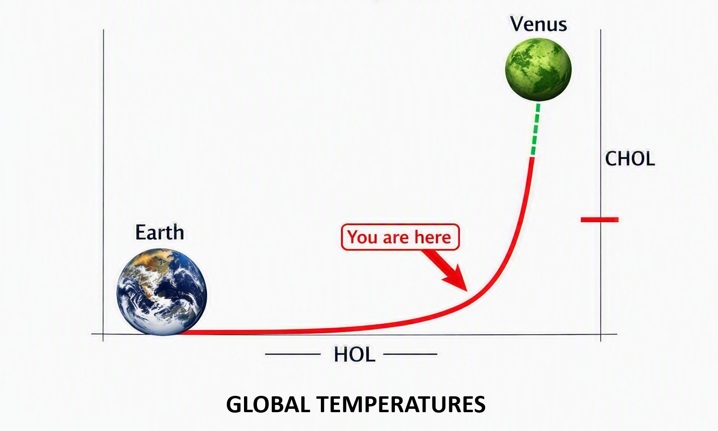
The curve represents the exponential acceleration of planetary warming. “You are here” marks the present inflection point.
Earth’s Venusification
Venus is a real example of what happens when a planet’s climate system enters runaway feedback. Its average surface temperature is around 867°F (464°C) — hot enough to melt lead. The planet is covered in a thick atmosphere of carbon dioxide, with clouds of sulfuric acid that rain downward before evaporating in the intense heat. Volcanic activity is widespread across the surface, and the pressure at ground level is more than 90 times that of Earth’s atmosphere.
Venus is not “hot” in the way people imagine. It is a world where the climate engine has locked into a permanent, self‑reinforcing state — a greenhouse feedback loop that never stops. Once the process began, the planet’s temperature didn’t rise gradually. It rose exponentially, until the entire system became uninhabitable.
Scientists believe Venus may once have had conditions suitable for liquid water, and possibly even life. Whether it truly supported life is irrelevant. What matters is that Venus stands as a signpost: a planet that crossed too many tipping points, too quickly, and entered a runaway state that could never reverse.
Zombie Trees
Across the Amazon, the Congo, and Southeast Asia, large portions of the rainforest are no longer functioning as living forests. During recent heat‑dome events — where a massive bubble of high‑pressure air traps heat over a region — the canopy was flash‑fried. The internal structure of the leaves collapsed, but the chlorophyll remained intact. Under a heat dome, the air does not circulate normally; the heat simply builds and builds until the forest shuts down.
These events pushed many trees into a comatose state. They still appear green from a distance, yet they are no longer performing the functions that define a living forest. They are not photosynthesizing normally. They are not producing rainfall. They are not regulating humidity. They are not storing carbon. They are using just enough biological energy to keep their leaves green — nothing more.
From space, satellites detect “greenness,” and early models assumed greenness meant life. But greenness is not life. Greenness is only color.
Why the Forests Were Misdiagnosed
For years, scientists relied heavily on satellite imagery to estimate forest health. Satellites measure reflectance — how green the canopy appears. But after the heat‑dome flash‑fry events, the leaves stayed green even though the trees were no longer active. This created the illusion of stability. The forests looked intact from above while collapsing from within.
Only when researchers entered the forests directly did the truth become clear: the trees were zombies — biologically present, visually green, but ecologically dead. They were no longer part of the climate engine. They were no longer producing the rainfall that sustains the world system. They were no longer buffering heat or storing carbon. They were simply standing in place, waiting to fall.
The Amazon, the Congo, and Southeast Asia are not “in danger.” They are already gone in the functional sense. Their collapse is not a future event — it is a present condition.
The Self‑Destruction Sequence
The world’s tipping points do not collapse randomly. They collapse in a sequence — each one triggering the next, each one amplifying the next, each one accelerating the next. This pattern is automatic. It is built into the design of Earth’s climate and ecosystem from the beginning. A system this interconnected cannot break in isolation. When one part fails, the others are forced to respond.
Once the first major tipping point is crossed, the sequence becomes self‑destructive. Drying forests weaken rainfall. Weak rainfall destabilizes soil. Destabilized soil reduces plant growth. Reduced plant growth increases heat. Increased heat melts ice faster. Faster melt disrupts ocean currents. Disrupted currents destabilize weather. Destabilized weather damages forests further. The loop tightens. The collapse accelerates.
This is not a chain that can be paused. It is a self‑sustaining process. Each failure amplifies the next failure. Each acceleration increases the next acceleration. The system begins feeding on itself, moving toward a new state that cannot support the world as it once was.
This sequence was always part of creation. Earth’s stability depends on balance; when the balance is broken, the system automatically shifts into correction. But when the imbalance becomes too great, the correction becomes irreversible. The tipping points were designed to protect the planet — but once overwhelmed, they become the mechanism of collapse.
And that mechanism has already been triggered.
Why Climate Timelines Keep Moving Closer
Early climate models were built on the assumption that global warming would increase at a steady, linear rate. Heat would rise predictably, ice would melt gradually, and major climate thresholds would arrive far in the future. These models reflected the best understanding available at the time, but they also treated Earth’s systems as if they were separate, simple, and slow to respond.
As real-world data accumulated, scientists began to see that many changes were not following those linear expectations. Ice sheets were melting faster than predicted. Forests were drying sooner than predicted. Permafrost was thawing deeper than predicted. Ocean currents were weakening more rapidly than predicted. The pace of change was not steady — it was accelerating.
Because of this accelerating behavior, some climatologists have expressed alarm that the breakdown may be occurring non-linearly, and in some cases exponentially. When one system destabilizes, it increases the stress on the next, and that next system collapses faster than models originally projected. This compounding effect forces scientists to update their timelines, moving projected dates for major climate thresholds closer and nearer.
What Happens If the Ice Falls Into the Sea
If the East Antarctic Ice Sheet, West Antarctic Ice Sheet, Greenland, and the world’s glaciers collapse into the ocean, the consequences are straightforward.
Sea levels rise dramatically — not by inches, but by tens of meters. Entire coastlines disappear. Every major coastal city becomes uninhabitable. Nations lose their land. Islands vanish completely. Ocean currents break down as cold, fresh meltwater disrupts circulation. Weather becomes chaotic. Food systems fail as climate zones shift. Governments destabilize under the pressure of mass migration. Heat accelerates because ice, which reflects sunlight, is replaced by dark ocean water that absorbs it.
Civilization as we know it cannot survive this combination of changes.
Babylon and the Modern World
Revelation’s Babylon is a global system built on commerce, greed, and idolatry. It collapses suddenly and cannot be rebuilt. The modern world is a global system built on consumption, extraction, and denial. It is crossing tipping points and cannot return to stability.
The symbolism and the physical reality align. Babylon falls under its own weight. So does the modern world.
The Millstone and the Glacier
John saw a massive object thrown into the sea, symbolizing the fall of a world system. Today, we see massive glaciers collapsing into the ocean, destabilizing the planet and ending the global system built on excess. The ancient metaphor and the modern mechanism describe the same event in different language.
When Ten Feet Is Enough to Break the World
Civilization does not need a 200–250 foot sea‑level rise to enter collapse. The global system is built on coastal infrastructure: ports, naval bases, refineries, and container terminals sitting at or near sea level. Long before the ice sheets deliver their full height, a smaller rise is sufficient to break the system.
A rise of roughly ten feet is enough to make the world’s major sea ports inoperable. When ports drown, transoceanic shipping stops. When shipping stops, worldwide navies lose their bases, fuel distribution fails, food imports cease, and global supply chains fracture. Economies do not “struggle” under this scenario — they fail.
Revelation describes sea captains mourning because no one buys their cargoes anymore, and kings of the earth standing far off watching the smoke of Babylon’s burning. This is the language of a global trade system that has died. When the ports are gone, the cargoes have no buyers. When the system burns, the rulers can only watch from a distance.
In biblical terms, a “city” is a metaphor for a system or world‑order, not just a single location. Babylon represents a global commercial structure built on greed and idolatry. The “seven hills” can be understood symbolically as the seven continents — a worldwide network of commerce and maritime trade.
The Thwaites "Doomsday" Glacier
The latest satellite analyses describe the Thwaites Eastern Ice Shelf as behaving like a structure “hanging on by a thread” — a phrase used by multiple glaciologists to characterize the partial detachment of its last remaining pinning point. This pinning point once stabilized the shelf by anchoring it to the seabed; its weakening signals imminent structural failure.
Glaciologists have also established that Antarctic glaciers do not melt primarily from above, but from beneath. Warm, dense circumpolar deep water intrudes under the ice, eroding it from the bottom up and turning the grounding zone into something like the old Slip ’N Slide toy: once the underside becomes slick, the glacier accelerates downslope with very little resistance.
Ice shelves act as buttresses: they hold back the glaciers behind them. When a shelf collapses, those glaciers accelerate toward the sea. The glaciers themselves sit on mountain slopes, so gravity and the slick, basal “Slip ’N Slide” effect do all the work once the underside is eroded. The massive glaciers just slide down into the sea below. The ice currently restrained by the Thwaites system represents on the order of ten to fifteen feet of potential global sea‑level rise once buttressing is lost and retreat begins.
The threshold for Babylon’s collapse is not theoretical. It is already being approached in the physical world.
The problem isn’t million‑dollar beach houses
Sea‑level rise of 10–15 feet does not merely erase luxury coastal real estate.
It erases entire cities, ports, distribution hubs, and
low‑lying nations. These are the places where food, medicine, tools, clothing,
electronics, and fuel enter the economy. When they go underwater, the physical geography that
supports ordinary life collapses.
Cities inundated at +10–15 feet
- New Orleans: Already below sea level; a 10‑foot rise permanently submerges most of the city.
- Miami: Downtown, Brickell, Miami Beach, and the airport go underwater.
- New York City: Lower Manhattan, Brooklyn waterfront, Queens, and Staten Island lose critical districts.
- Boston: Seaport, Back Bay, Logan Airport, and major tunnels inundated.
- Seattle: Harbor Island, industrial zones, and waterfront neighborhoods submerged.
- San Francisco: Embarcadero, Mission Bay, and SFO airport flooded.
- Houston and Galveston: Ports, refineries, and petrochemical complexes inundated.
- Jakarta: Already sinking; ten feet of rise erases vast portions of the city.
- Shanghai: Major districts of the world’s largest port go underwater.
- Alexandria: Nile Delta subsidence combined with sea‑level rise drowns historic districts.
- Copenhagen: Low‑lying capital flooded; Denmark’s infrastructure collapses.
- Dhaka: Deltaic city overwhelmed; tens of millions displaced.
Staggering complexity of scarcity
The collapse of these cities is not symbolic; it is mechanical. They are the nodes through which
global supply chains operate. When ports and coastal logistics hubs drown, container shipping,
naval resupply, fuel distribution, food imports, pharmaceutical imports, electronics imports,
and manufacturing inputs all suffer a hard stop. Scarcity is no longer a matter of price or
policy; it becomes a matter of physical impossibility.
Major retailers such as Walmart, Target, Costco, and Home Depot operate on just‑in‑time logistics.
Typical stores carry only a few days of inventory for fast‑moving goods, and distribution centers
carry roughly one to two weeks. If the ports that feed these networks are lost, then even without
panic buying, Walmart’s shelves would be largely empty within two to three weeks—and they
would not refill. The system that delivers goods ceases to exist, and scarcity becomes structural,
cascading through every aspect of daily life.
The End of E‑Commerce and the Digital World
A sea‑level rise of 10–15 feet does not only drown ports and coastal cities.
It drowns the physical infrastructure that makes e‑commerce, digital communication, and
modern finance possible. The systems people treat as “virtual” are built on hardware
sitting at or near sea level: fiber‑optic landing stations, data centers, exchanges,
banks, warehouses, and power grids.
E‑commerce without ports is impossible
Global e‑commerce depends on coastal fulfillment centers, warehouses, ports, and airports.
When ports drown, container ships cannot dock, air freight cannot move, and coastal
distribution hubs are lost. Automation systems, robotics, and inventory routing software
have nothing to manage because there are no goods arriving. E‑commerce does not slow
down under these conditions; it stops.
The internet fractures when the coast goes under
Subsea fiber‑optic cables come ashore at low‑lying coastal landing stations. Major data
centers are built near these landing points and near coastal power infrastructure.
A 10–15 foot rise floods landing stations, power substations, cooling systems, and
server halls. Backbone routing fails, cloud services go dark, and the global internet
breaks into unstable, regional fragments. The “cloud” disappears because the buildings
that house it are underwater.
Mobile phones lose their network and their apps
Modern mobile phones are thin clients that depend on apps, cloud services, and continuous
connectivity. Cell towers, base stations, and switching centers are tied into the same
coastal fiber and power networks that serve data centers and exchanges. When those
networks fail, phones may still power on, but most of what makes them “smart” stops
working: messaging apps, navigation, payments, banking, authentication, and online
commerce. Devices become mostly offline tools, not gateways to a functioning world.
The power grid does not survive a ten‑foot rise. Coastal substations, transformers, and switching yards drown first, severing regional transmission. Fuel supply chains collapse when ports go under—coal, LNG, diesel, and replacement parts all arrive by ship. And the power plants themselves depend on stable cooling water systems that fail when intake channels flood or become contaminated. Without power, data centers go dark, fiber networks go silent, warehouses shut down, and mobile networks collapse. The digital world does not die because the satellites fail; it dies because the electricity that makes every part of modern life possible can no longer be delivered.
Your portfolio under ten feet of water
In this scenario, e‑commerce dies, the internet fractures, mobile phones lose their
network, and the financial system drowns. The digital and economic structures that once
defined normal life are replaced by a single priority: survival. Research, investment,
and online activity become trivial pursuits in a world where the infrastructure that
supported them has been erased.
Modern wealth is not abstract. It is recorded in servers, exchanges, banks, and custodial institutions concentrated in coastal financial districts—Wall Street, the City of London, Singapore’s waterfront, Hong Kong’s Central, Shanghai’s Pudong. A 10–15 foot rise places the physical substrate of the global financial system under water. “Your portfolio” is not simply devalued; it is stranded inside a system that no longer exists in operational form. And the companies you are invested in are not announcing quarterly earnings—they are announcing that their headquarters are gone and their leadership has drowned. A portfolio is meaningless when the world that records ownership has ceased to exist.
The Cascading Failure of the Earth System
A ten‑foot rise is not the end of the story. It is the beginning of a chain reaction.
Once the ice shelves fail and the ports drown, the planet begins revealing tipping points
that were invisible in a stable climate.
Freshwater pulses weaken the Atlantic overturning circulation, not by freezing Europe,
but by destabilizing weather patterns, monsoons, and jet‑stream flow. The Southern Ocean
stops ventilating heat, accelerating the melt of the remaining ice shelves. The grounding
lines of the East Antarctic Ice Sheet begin to float, unlocking far larger volumes of ice.
Submarine landslides trigger regional tsunamis. Jet‑stream patterns fracture into permanent
heat domes and stalled storms. Groundwater rises far inland, flooding cities from below
even before seawater reaches them.
These tipping points are not theoretical in the abstract sense; they are the natural
consequences of destabilizing the ocean, the atmosphere, and the cryosphere at the same
time. Each one accelerates the next. Each one makes recovery impossible. The world system
does not simply fall — it unravels.
The Limits of Prediction
No one truly knows what other tipping points will emerge once the ice shelves fail.
Not even the scientists who study Earth’s systems can fully discern the thresholds that
lie beyond the first collapse. Complex systems reveal their hidden weaknesses only after
they are pushed past stability. New feedbacks appear. Old assumptions break. The world
does not simply change — it enters a state no model can fully describe. What follows is
not uncertainty in the sense of doubt, but uncertainty in the sense of discovery: the
unveiling of consequences that were always present, but invisible until the moment of
collapse.
At that stage, people will be too busy trying to survive to continue studying the collapse.
Research becomes a luxury, a trivial pursuit carried out only by those with the time and
resources to analyze a world that no longer exists. The system that once funded, staffed,
and sustained scientific inquiry will be gone, and survival will eclipse curiosity.
“Every Island Fled Away” — Revelation 16:20
John described the effect: islands disappearing. Today we understand the cause: massive sea‑level rise from collapsing ice sheets. When tens of meters of water enter the ocean, islands do not sink slowly. They vanish. Coastlines drown. Nations disappear. The world map changes permanently.
By the time this level of sea‑level rise occurs, civilization will already have been dismantled; the disappearance of islands is not the beginning of collapse, but the final stage of a process already underway.
Final Takeaway
Global warming is not just hotter weather. It is the collapse of the world system — the ecosystem, the climate engine, and the civilization built on them. Revelation describes Babylon falling. Global warming shows how it falls.
The “millstone” is the glacier. The “sea” is the destabilized ocean. The “fall of Babylon” is the collapse of the global system built on commerce, greed, and idolatry.
Summary — The Tipping Points Working Together
The tipping points described in this chapter are not waiting for a future moment. They are already active, already reinforcing one another, and already driving the world system toward collapse. The drying forests weaken rainfall, the dying reefs alter ocean chemistry, the thawing permafrost releases methane, and the melting ice sheets accelerate sea‑level rise — each one pushing the next forward.
The end is not approaching — it is unfolding. And every effort to halt it has only accelerated the very system ensuring its destruction. Like it or not, believe it or not — it's irrelevant. This is worldwide Babylon and its foretold destruction has been ongoing for some time.
Final Note
As I noted in my eBook, there is evidence that God is accelerating directly to the very End of Time and bypassing the scheduled collapse of Earth’s ecosystems. The world was originally designed to fail gradually through the tipping‑point sequence embedded in creation itself, but the pattern now indicates a forward acceleration — a compression of the timeline. Instead of allowing the slow, natural breakdown of the ecosystem to run its full course, the process is being shortened. The restraint is lifting, the delay is ending, and the world is being moved directly to the final moment.
This acceleration aligns with the same signals documented in the Finality analysis, the calendrical convergence of Rosh Hashanah and the Coptic New Year, the warning given to Thamud and the Camel of God, and the irreversible structure of the Clenched Fist Trap. Each of these pages reflects a different facet of the same conclusion: the days are being cut short, exactly as Jesus stated, and the world is being carried to the End ahead of the natural schedule.
“Rejoice over her, you heavens!
Rejoice, you people of God!
Rejoice, apostles and prophets!
For God has judged her
with the judgment she imposed on you.” — Revelation 18:20
Rejoice Over Her — Babylon Has Fallen Never to be Found Again
Revelation describes the collapse of a global system. The physical world now shows the same pattern: the structures that held civilization together are failing, and the consequences are unfolding exactly as written.
“And unless those days should be shortened, there should no flesh be saved; but for the elect’s sake, those days shall be shortened.” — Jesus
The final loud voice from heaven declares: “Come out of her, my people, so you will not share in her sins or receive her plagues.” This is not metaphor. It is instruction. It is covenant language.
Covenant = Life. Outside the covenant, there is only participation in Babylon’s collapse. Inside the covenant, there is preservation, shortening of days, and deliverance.
God always identifies and saves His Own People before He destroys a place. The mechanics of how He saves them are irrelevant; He makes a way even when no way is visible, just as He did for the Israelites at the Red Sea when escape seemed impossible. They were completely cornered, trapped between the water and the army, and only became aware of God’s solution at the moment it occurred. That is the correct form of “faith over fear”: not denying reality, but seeing it clearly and trusting the covenant that operates beyond it.
When the Waters of Life Become the Flame
Earlier, the Hol → Chol pattern was shown in the Earth–Venus graph: the waters of life cease to be
life‑giving and become the fiery flame. This is not just a scientific trajectory; it is the foundational
tenet of the Hebrew phoenix. Hol is the Holy Spirit over the waters of life and Chol is the Holy Spirit as a Fiery Phoenix. The transition from one to the other
is the moment when God changes its role — when the waters that sustained life become the
mechanism of destruction.
Revelation encodes this same pattern symbolically. The “lake of fire” is the Hol → Chol event expressed
in prophetic language: the final transformation of the life‑supporting system into the consuming flame.
It is not arbitrary judgment; it is the inevitable consequence of a world-system reaching the point where
its sustaining forces invert.
Who Are God's People?
No one knows for sure. Taking a census of God’s People is prohibited; only God counts His Own. But the text itself
gives the only reasonable presumption: He chooses those who keep their covenants. Revelation 22:14 describes those
who “do His commandments” and therefore have the right to the tree of life, while verse 15 describes those outside —
excluded from preservation when the system transitions from Hol to Chol.
14 Blessed are they that do his commandments, that they may have right to the tree of life, and may
enter in through the gates into the city.
15 For without are dogs, and sorcerers, and whoremongers, and murderers, and idolaters, and
whosoever loveth and maketh a lie.
16 I Jesus have sent mine angel to testify unto you these things in the churches. I am the root and
the offspring of David, and the bright and morning star.
Revelation 22:14–16 (KJV)
The phrase “do His commandments” uses the Greek word entolai, meaning the covenant directives given by Him —
not a legal code. It does not specify which covenant; it simply refers to those who keep the terms of the covenant
they have been given.
When the waters of life cease to be life‑giving, your only remaining life‑support system becomes your covenant.
Revelation 22:14 describes those who have access to life because they remain within the covenant, while verse 15
describes those outside it — excluded from preservation when the system transitions from Hol to Chol. The divide is
absolute: covenant followers versus non‑covenant participants. And the reason for that divide is stated plainly in
the text itself: Jesus establishes the terms of life, and those who keep his commandments — the entolai, the
covenant directives given by Him (not specifying which covenant) — are the ones who enter through the gates into the
city.
Related Page: The Finality
A continuation of this theme expressed through songs, symbols, placement, and imagery in addition to text.
The Finality page presents the covenant divide and the Hol → Chol transition in their completed form —
explained by being shown.